

-
Interesting Talks/Notes from GDC 2010…
Posted on March 17th, 2010 No commentsHey,
I made a list and took some notes on the more interesting sessions at GDC that may be relevant to smaller game developers looking to get players…here are some write-ups with more info on them…
Social Games in Japan:
http://www.slideshare.net/d3ntaku/jp-soc-games-v03 (these are the slides on the Japanese mobile social networks…the mafia game is called Kaitou Royale…and is reportedly making several million dollars each month)Sporadic Play:
http://www.raphkoster.com/2010/03/10/gdc10-sporadic-play/
http://kotaku.com/5493252/call-of-duty-for-the-rest-of-them (this explains a potential implementation of Sporadic play)Scaling Farmville:
http://www.raphkoster.com/2010/03/12/gdc10-scaling-social-games-robert-zubek/Designing for Parents + Kids:
http://www.slideshare.net/jesseschell/designing-for-kids-and-parents-playing-together-3388050Five Ways Games Can Make You Cry:
http://gamesnewsinfo.blogspot.com/2010/03/amiga-five-ways-games-can-make-you-cry.htmlInteresting Stats from Facebook Talk:
400 million users on FB, just getting started as there are 1.7 billion folks on the Internet
does not include mobileOver 3 billion photos uploaded every month on FB
FlashForward demo shows the power of social data to make a compelling experience
Incorporating real events into online play….
People are getting real-world flowers via online gameplay (Pet Society did this during Valentines)Sharing is a popular social activity
Indie Social Game Development Talk by Loud Crowd CEO:
Discussed their latest game, Music Pets
Talked about how they went from 0 users to about 60,000 daily usersFirst they came up with 5 solid ideas they would love to develop. Put up ads on Facebook to see which one attracted the most users. The one with the highest click-through was “Music Pets”
When people clicked on the ad, they were taken to the app. If they installed, they saw a page that said “Coming Soon”
They developed the game and released it…and kept iterating and improving it. It is now an entirely different game thatn it was 7 weeks ago…but players still here…because involves in helping to build the game
Players like choice…make sure you allow a lot of ways to customize things in the game…like lots of items in the store, etc.
Paperback Writer: The Emergence of Interactive Story …
Stories in games helps to create irrational loyaltyLessons Learned for Effective Stories In Games…
a) Super important to ease them into the experience
b) Remind player what they should be doing at all times
c) Keep the story light and fun
d) Provide plenty of instructions and hints
e) Show progress -
Student Project: First-Person Dish Washing Game…
Posted on March 14th, 2010 No commentsHey folks,
Here’s a game development interview taken from the Independent Games Festival last year…a group of students made a “First-Person Dish Washing Game”…
[wp_youtube]DGgONKtjqhI[/wp_youtube]
-
Feedback For The Show…
Posted on February 12th, 2010 No commentsHey folks,
In the past year, we’ve experimented with new features for the show…mainly…
a) Adding some video interviews
b) Releasing more podcasts…that were shorter than the hour-long interviews from before…and more focused…we have focused on more of the game design and technical aspects
c) Releasing free game dev books…like the free book on social game development
d) Releasing free code … like the free code for social and flash games
e) Releasing free artwork … this is a work in progress
f) Transcribed all podcasts
g) Worked on a “community” project…where we share information on a game and ask the community for feedback
h) Free giveaways and contests
The question is…what has worked for you…what have you found useful. What suggestions do you have to make this show better in the upcoming year.
We aim to add a few new features each year…and some things we are thinking of implementing are…
a) releasing more free game design books
b) more free artwork.Any other suggestions? We’re open to all crazy and fun suggestions 🙂
Let us know of any topics you want us to cover more 🙂
We want to take all the feedback and implement them before we do interviews at the upcoming Game Developers Conference
Thx 🙂
-
Game Design Review: WarStorm
Posted on December 25th, 2009 No commentsHey folks,
This show is dedicated to experimental games. With that said, we’re introducing a new feature. We’re going to have game design reviews of various games. We’ll focus on the game mechanics behind the games. For now, we’ll cover games on some of the new platforms … like social games, iPhone games, and alternate reality games.
Each review will focus on the game mechanics that make the game fun…as well as potential new mechanics that would enhance the experience. Feel free to post feedback.
Game Name: WarStorm
Game Link: http://www.facebook.com/apps/application.php?id=29507308663
Overview: In Warstorm: Challenges the player collects cards representing troops in a vast army. He builds decks in 7-card segments called “squads,” and then pits one to four squads against the computer or other players. There is a campaign mode, an arena, and a “daily campaign,” which is a new feature for the Facebook version of the game.
Collection: Warstorm: Challenges has this mechanic in spades. There are literally hundreds of cards to collect, and a player can theoretically include as many as 36 copies of one card in his deck. With certain card combinations that produce massive results in the game, there is a strong impetus to keep collecting more and more cards.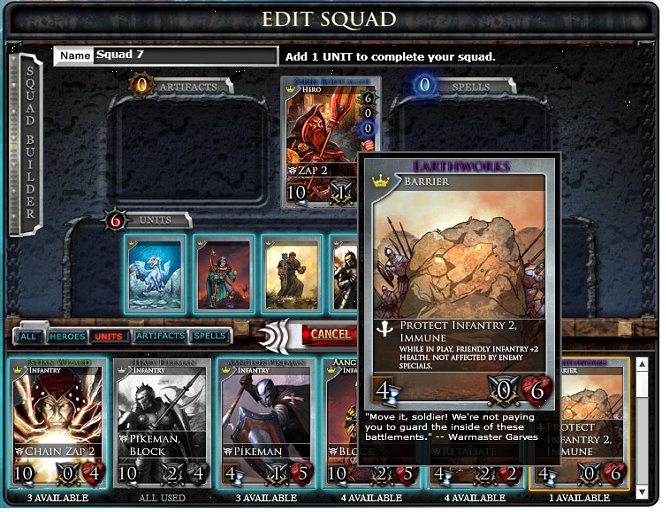
Purchased Collecting: The player can buy “novice” cards fairly cheaply, or the more advanced “expert” cards for a higher price. Playing against another player in their arena mode earns you points whether you win or lose, so the collection mechanic feeds back in and directly encourages the player to keep playing.
No Choices: For all the options the player has when putting together a deck, there is no decision-making once the battle begins. The game runs a simulation for how the decks clash and determines a winner. The positive side of this is that the more casual player doesn’t feel pressured to sit in place for half an hour while an opponent decides on moves in real-time. The negative side is that players often feel that they aren’t really playing the game (I’ve surveyed friends who tried this out, and it’s a frequent complaint in the forums).
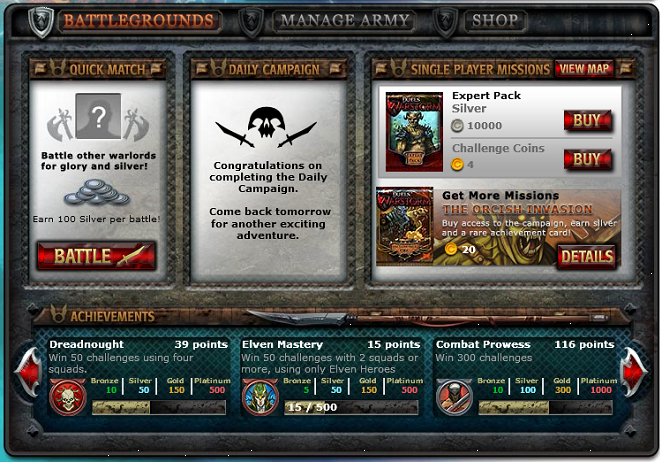
Achievement: In the previous iteration of the game, on a separate site, Warstorm did very well by having a nice large achievement section for the player to reference. In the Facebook version they’ve improved on that design by placing the achievements you’re closest to achieving front and center on your main page. When I ran out of campaigns to overcome in the old edition, achievements are what kept me playing for a few more weeks.
Updated Content: This version does an even better job of providing a compelling play experience by including the “daily campaign.” Essentially, each day there is a new specific deck to defeat. Because the core of “gameplay” in Warstorm: Challenges is the building of the deck (this is where the player can make strategic decisions that affect his outcome), the inclusion of set decks to defeat makes Warstorm an actual game, not just a collection mechanic attached to a card game simulation.
Art: The art is middling. The card art loses a lot of its punch on the new smaller size Facebook permits, and the new interface additions make things feel a little crowded. On the other hand, every individual piece of art is quite decent and supports the general swords and sorcery theme.
Story: Not integrated enough. I’m a player whose primary interest is often in storyline, and I skip past the text that tells the story of why I’m having this or that battle, because I just don’t care and it never impacts gameplay. When I do read it, the writing is so-so; decent but unmemorable.
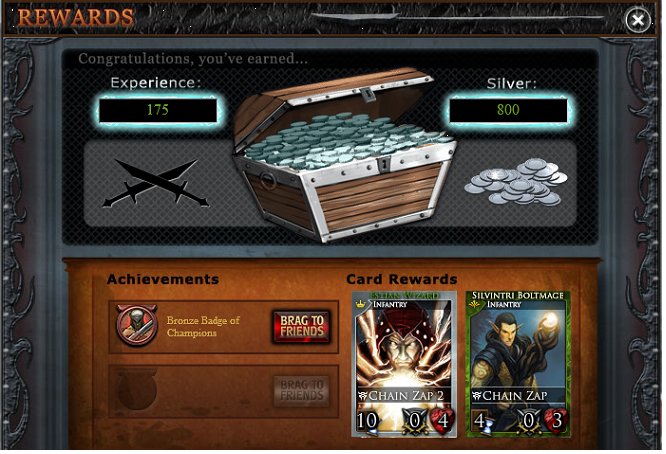
Well-Implemented Notification: When you gain an achievement in Warstorm, you get a button on the mission briefing entitled “brag to friends.” Because it’s built into the system it’s less obtrusive than the usual pop-up, and the tiny shift in wording makes it surprisingly enticing.
Player-Generated Content: This is the big thing missing, in my opinion. The players should be able to challenge one another with “towers” or some similar structure, with one player making a deck and others trying to beat it as the day wears on. This would allow the game (that is, the part where you’re designing a deck) to remain interesting for, essentially, an infinite amount of time. The reward structure would be difficult to devise, but it would take the game experience to the next level, even for the social or casual gamer.
Overview: In Warstorm: Challenges the player collects cards representing troops in a vast army. He builds decks in 7-card segments called “squads,” and then pits one to four squads against the computer or other players. There is a campaign mode, an arena, and a “daily campaign,” which is a new feature for the Facebook version of the game.

Collection: Warstorm: Challenges has this mechanic in spades. There are literally hundreds of cards to collect, and a player can theoretically include as many as 36 copies of one card in his deck. With certain card combinations that produce massive results in the game, there is a strong impetus to keep collecting more and more cards.Purchased Collecting: The player can buy “novice” cards fairly cheaply, or the more advanced “expert” cards for a higher price. Playing against another player in their arena mode earns you points whether you win or lose, so the collection mechanic feeds back in and directly encourages the player to keep playing.
No Choices: For all the options the player has when putting together a deck, there is no decision-making once the battle begins. The game runs a simulation for how the decks clash and determines a winner. The positive side of this is that the more casual player doesn’t feel pressured to sit in place for half an hour while an opponent decides on moves in real-time. The negative side is that players often feel that they aren’t really playing the game (I’ve surveyed friends who tried this out, and it’s a frequent complaint in the forums).
Achievement: In the previous iteration of the game, on a separate site, Warstorm did very well by having a nice large achievement section for the player to reference. In the Facebook version they’ve improved on that design by placing the achievements you’re closest to achieving front and center on your main page. When I ran out of campaigns to overcome in the old edition, achievements are what kept me playing for a few more weeks.

Updated Content: This version does an even better job of providing a compelling play experience by including the “daily campaign.” Essentially, each day there is a new specific deck to defeat. Because the core of “gameplay” in Warstorm: Challenges is the building of the deck (this is where the player can make strategic decisions that affect his outcome), the inclusion of set decks to defeat makes Warstorm an actual game, not just a collection mechanic attached to a card game simulation.
Art: The art is middling. The card art loses a lot of its punch on the new smaller size Facebook permits, and the new interface additions make things feel a little crowded. On the other hand, every individual piece of art is quite decent and supports the general swords and sorcery theme.
Story: Not integrated enough. I’m a player whose primary interest is often in storyline, and I skip past the text that tells the story of why I’m having this or that battle, because I just don’t care and it never impacts gameplay. When I do read it, the writing is so-so; decent but unmemorable.

Well-Implemented Notification: When you gain an achievement in Warstorm, you get a button on the mission briefing entitled “brag to friends.” Because it’s built into the system it’s less obtrusive than the usual pop-up, and the tiny shift in wording makes it surprisingly enticing.Player-Generated Content: This is the big thing missing, in my opinion. The players should be able to challenge one another with “towers” or some similar structure, with one player making a deck and others trying to beat it as the day wears on. This would allow the game (that is, the part where you’re designing a deck) to remain interesting for, essentially, an infinite amount of time. The reward structure would be difficult to devise, but it would take the game experience to the next level, even for the social or casual gamer.
-
Experimental Game Dev Project….Update
Posted on November 14th, 2009 No commentsHey folks,
As mentioned before, we’re going to change the model for the game development. Specifically, we’re going to discuss a current game in progress and the listeners can provide feedback/opinions to help enhance the game…the core team may take the suggestions.
In this case, the game is called “Whatever Quest”…this will be an public-service project…with the goal of making a free game that everyone in the world can use.
Wikipedia is a great way to find information on any topic in the world. But…what happens when you want to find/access any experience in the world. Wikis/web pages aren’t perfect for that…but games are perfect for that…the goal of “Whatever Quest” is to “game-ify” all of the experiences in the world.
For example, if someone wants to go through the experience of training for a marathon, they would be able to go on here and find quests that they can join to help them train for a marathon.
This project is much more experimental and novel than the original space-shooter project…so let’s see how this works out.
You can check out the game here…
http://apps.facebook.com/whateverquest/Post feedback below 🙂
-
Free Open Source Flash Mini Game…
Posted on November 10th, 2009 No commentsHey folks,
Here’s another flash mini-game that is open sourced 🙂
Feel free to use/modify it for your games 🙂
-
Community Game Dev Project Update…
Posted on November 7th, 2009 No commentsHey folks,
Based on some suggestions, we’re going to revise the first project a little. Specifically, the goal of these projects is to do something in a new and experimental area of gaming.
Making a variation on a shooter game falls short of this goal. So we’re going to revise the project to focus on more innovative areas of games. For example, we may do an ARG in the future. For now, we’ll focus on some of these games on social networks.
The way this will work is that we’ll have an indie team that is already working on a game show it off. Then folks in the community can offer feedback, etc. The team may take the feedback or not…it’s up to them since it’s their game. However, they will share stats/updates on the game so that folks have an idea of how things are going with the game.
These dev projects offer other indie/experimental game devs a feeling of creating a new game without having to dedicate time/resources to making it work.
With that said, “Community Game Dev” seems to be a misnomer…post any suggestions on what these projects should be called in the comments below. Thx 🙂
Maybe something like “Experimental Game Dev” project?
Details on the first game should come out next week.
-
Using Games to Get People To Recycle…
Posted on November 1st, 2009 No commentsHere’s an interesting and compelling use of games to get people to recycle…a glimpse on the power of fun to change behavior…
-
Announcing the “Community Game Dev” project…
Posted on October 31st, 2009 No commentsThe show is going to try a little experiment…mainly, we’re going to have a little “community game dev” project…something that will be developed on the show…and listeners can provide feedback/suggestions/modifications…and the game will get updated accordingly.
This will be a good way to get some experience in developing a simple game…and will keep things interesting.
The goal is to make a game that is interesting, unique, and gets played. Every aspect of these projects will be transparent including play and revenue stats.
Let’s keep the first project simple…it’ll build off the open sourced space shooter code recently posted on the site.
Here is the working version of it…this will be version 1.0….post your suggestions for the next step in the comments below. We’ll spend the next 2 weeks iterating on this project and then “releasing” it to players around the world 🙂
-
Indie Version of Unity Now Free…
Posted on October 29th, 2009 No commentsHey folks,
The indie version of Unity is now FREE…you can check it out here…
http://unity3d.com/unity/download/